

12 November 2024
Athletic Performance Insider

WELCOME😊
Keeping up with new research is a challenge, even for dedicated academics. The Athletic Performance Insider newsletter addresses this challenge by summarising new research into bite-sized chunks that can be read in about ten minutes. Relevant studies on performance are selected and summarised, and links to the original research papers are provided for anyone seeking more information.
This week, a study addresses the question,”Can heavy lifting transform your tendons?” The simple answer is yes, and tendons can be targeted to improve their health and resistance to overuse. Read the summary to find out more.
Another study investigates how flywheel training adds another dimension to resistance training and induces specific muscle adaptations.
A study of a new smartphone app that measures flight time is summarised. The algorithm in the app addresses the limitations of the traditional flight-time method, which overestimates jump height due to lower limb flexion during landing.
Another study analysed three decades of data to understand why some Ironman triathletes cramp during the race. The findings are interesting, and the study confirmed that electrolyte deficiency is not the primary cause, as many supplement companies would like you to believe.
Another study, with useful practical applications, examines the protocol for optimal strength gains in resistance training.
Finally, a commentary discusses the physiological paradox and risk of autonomic dysfunction when artistic swimmers train and compete. The authors explain how this is caused by a high exertion level while holding their breath. This is Physiology 101.
The Athletic Performance Insider newsletter is published weekly and presents up-to-date research, exclusive interviews, practical tips, and the latest industry news and trends.
If you want the newsletter delivered to your mailbox every Tuesday, press the subscribe button.

RESEARCH🧐
Can heavy lifting transform your tendons?
Comstock, B. A., Flanagan, S. D., Denegar, C. R., Newton, R. U., Häkkinen, K., Volek, J. S., Maresh, C. M. & Kraemer, W. J. Structural and Functional Properties of Lower Extremity Tendons in Men. J. Strength Cond. Res. (2024).
This study investigates the structural and functional properties of the patellar and Achilles tendons in young men engaged in heavy resistance training compared to recreationally active men. The research question focuses on how resistance training affects tendon structure, function, body composition, and serum collagen turnover biomarkers.
The study included 26 men, divided into resistance-training and non-resistance-trained groups. Their tendon properties were assessed using ultrasonography and dynamometry. Lean body mass and bone mineral density were measured with dual X-ray absorptiometry, and serum collagen turnover markers were analysed.
Key findings indicate that the resistance-training men had significantly greater lean body mass, bone mineral density, patellar tendon stiffness, and Young’s modulus* [see below] than non-resistance-training men. However, the patellar tendon cross-sectional area did not differ significantly, and Achilles tendon properties showed mixed results. Serum collagen markers showed no significant differences between groups.
The study concludes that resistance training induces specific tendon adaptations, enhancing load-bearing capacity and efficiency. These results suggest that targeted resistance training can improve tendon health and function, potentially reducing injury risk and enhancing athletic performance by strengthening tendons and supporting musculoskeletal health.
*Young's modulus, also known as the elastic modulus, is a measure of a material's stiffness or rigidity.. A higher Young's modulus indicates that the material is stiffer and less prone to deformation under stress. In the context of tendons, changes in Young's modulus reflect alterations in their material properties, such as increased collagen fibre alignment and cross-linking, which enhance the tendon's ability to handle mechanical loads.

Flywheel training adds another dimension to resistance training
Banks, N. F., Berry, A. C., Rogers, E. M. & Jenkins, N. D. M. Flywheel resistance training promotes unique muscle architectural and performance‐related adaptations in young adults. Eur. J. Sport Sci. (2024).
This study investigates the effects of flywheel resistance training* [see below] compared to traditional resistance training on muscle architecture and performance in young adults.
The research question is whether flywheel resistance training offers unique muscle structure and function adaptations. Thirty-one healthy young adults were randomised into three groups: traditional resistance training, flywheel resistance training, or a control group, over a 10-week period. Key performance metrics such as maximal voluntary isometric torque, one repetition maximum and jump performance were measured alongside muscle hypertrophy and architectural changes.
Results showed that both traditional resistance training and flywheel resistance training increased maximal voluntary isometric and fat-free mass compared to the control group. However, traditional resistance training led to superior improvements in free-weight exercises, while flywheel resistance training enhanced flywheel-specific exercises, fascicle length, and jump performance. Flywheel resistance training uniquely increased the cross-sectional area of the distal vastus lateralis and improved jump metrics, suggesting distinct architectural adaptations.
The study concludes that flywheel resistance training provides a novel training stimulus that enhances athletic performance through unique muscle adaptations. Practically, flywheel resistance training can target specific muscle architecture changes and improve jump performance, offering an alternative to traditional resistance training for athletes seeking particular performance enhancements.
[Flywheel resistance training is a form of exercise that uses a flywheel device to provide resistance. Unlike traditional weight training, which relies on gravity, flywheel resistance training uses the inertia of a spinning flywheel to create resistance. During the concentric phase of a movement, the user spins the flywheel, storing kinetic energy. This energy must be resisted during the eccentric phase, providing a more significant eccentric stimulus than traditional isotonic resistance training].
A more accurate way to measure flight time in a vertical jump?
Nishioka, T., Yamaguchi, S. & Inami, T. Flight-Time Method Modified: Development of a Novel and More Accurate Method for Measuring Vertical Jump Height Using a Smartphone Application. Int. J. Sports Physiol. Perform. 1–9 (2024).
This study investigates a new method for measuring vertical jump height using a smartphone application. It addresses the limitations of the traditional flight-time method, which overestimates jump height due to lower limb flexion at landing.
The research question focuses on whether the modified flight-time method offers more accurate and reliable jump height measurements than the traditional method.
The study involved 24 male participants performing six countermovement jumps on force plates while being recorded with a high-speed smartphone camera. Jump height was calculated using the impulse–momentum method, the traditional flight-time method, and the modified flight-time method.
· The impulse–momentum method is the gold standard for measuring jump height. It involves using force plates to measure the force exerted by the jumper on the ground over time. These data helps calculate the takeoff velocity, which is then used to determine the jump height. It's accurate but requires expensive equipment and technical expertise.
· The traditional flight-time method estimates jump height by measuring a person's time in the air during a jump. The longer the flight time, the higher the jump is assumed to be. However, this method can overestimate jump height, especially if the jumper bends their knees when landing.
· The modified flight-time method improves upon the traditional method by using a smartphone app to track the movement of a specific body marker (the greater trochanter) during the jump. This approach accounts for changes in body position, like knee bending, making it more accurate and reliable than the traditional method.
Results showed that the jump height calculated using the traditional flight-time method was significantly higher than that calculated by impulse-momentum, while the modified flight-time method showed no significant difference from the impulse-momentum method. The modified flight-time method had a stronger correlation with the impulse-momentum method (ρ = .987) than the traditional flight-time method (ρ = .882), indicating higher validity and reliability. The study concludes that the modified flight-time method is a more accurate and reliable method for measuring jump height for practitioners to measure jump height in the field, facilitating optimal training techniques for athletes without the need for expensive equipment.

Why are some ironman triathletes cramping?
Nilssen, P. K., Johnson, K. B., Hiller, W. D. B., Miller, T. K. & Connolly, C. P. Exercise-Associated Muscle Cramps in Ironman-Distance Triathletes Over 3 Decades. Clin. J. Sport Med. (2024).
This study investigates the prevalence and factors associated with exercise-associated muscle cramps (EAMCs) in Ironman-distance triathletes over three decades involving 49 530 participants. The research question focuses on identifying trends and potential causes of EAMCs in this athlete population. The study involved a retrospective analysis of data from triathletes participating in Ironman events, examining age, gender, training habits, and race conditions.
Key findings indicate that EAMCs are a common issue among triathletes, with an overall prevalence of 5.8%. (n = 2863 cramps in this study). They were compared to triathletes who finished the race without needing medical care for cramping.
Factors like inadequate training, and dehydration contributed to its occurrence. Athletes with EAMC had greater weight loss but did not differ in serum sodium and serum potassium compared with those without EAMC. Further analysis revealed that dehydration, exhaustion, hypotension, abdominal pain, headaches, and a previous evaluation for cramping were strongly associated with muscle cramping. The study also highlights that older athletes and those with a history of cramps are more susceptible. The most common treatment for EAMC was intravenous fluids.
The conclusion emphasises the need for targeted interventions to reduce the incidence of EAMCs.

PRACTICAL 🤔
Is less more? Unveiling the protocol for optimal strength gains in resistance training
Páez-Maldonado, J. A., Cano, C., Cornejo-Daza, P. J., Sánchez-Valdepeñas, J., Rodiles-Guerrero, L., Wernbom, M., Ortega-Becerra, M. & Pareja-Blanco, F. Effects of Training Volume in the Bench-Press Exercise Performed With Interrepetition Rest Periods on Strength Gains and Neuromuscular Adaptations. Int. J. Sports Physiol. Perform. 1–10 (2024).
This study investigates the effects of different training volumes in the bench press exercise, on strength gains and neuromuscular adaptations.
Forty-three resistance-trained men were divided into three groups: low (LOW), moderate (MOD), and high (HIG) volume. Over eight weeks, participants trained with intensities ranging from 70% to 85% of their one-repetition maximum (1RM). During the 18-session training period, LOW performed 48 reps, MOD completed 180 reps, and HIG executed 312 reps. Progressive loading and fatigue tests were conducted before and after the training, with electromyography (EMG) signals recorded from the triceps brachii.
Results showed that all groups improved significantly in strength-related variables, with MOD achieving the greatest effect sizes. However, no significant differences in performance gains were observed between groups, despite the varying training volumes. The study concludes that moderate training volume may be optimal for strength gains without excessive repetitions. Practically, this suggests that resistance training programs can be designed with moderate volume to efficiently enhance strength, potentially reducing the risk of overtraining and optimising training time.
INSIGHTS 💡
Is artistic swimming a dance with danger?
Williams, E. L., Mathias, C. J., Sanatani, S., Tipton, M. J. & Claydon, V. E. In at the deep end: the physiological challenges associated with artistic swimming. Clin. Auton. Res. 34, 619–624 (2024).
Artistic swimming, previously known as synchronised swimming, is an Olympic sport that combines swimming, dance, and gymnastics. It requires high physical exertion and prolonged breath-holding. These routines, lasting 2 to 5 minutes, can involve breath-holding for over 50% of the time, creating a unique physiological stress. Conflicting autonomic responses compound this stress: the sympathetic "fight and flight" and parasympathetic "rest and digest" systems.
This autonomic conflict can lead to unpredictable physiological effects, including rare syncope (fainting) during routines, posing safety risks. The mechanisms behind these syncopal events are not well understood but may involve shallow-water blackouts and cardiac arrhythmias, exacerbated by long breath-holds. Heart rate fluctuations are significant, with near-maximal rates during surface exercise and abrupt decelerations during breath-holds. Performance anxiety and competition stress can further increase heart rate variability, potentially increasing syncope risk. Factors like relative energy deficiency and disordered eating, prevalent in this aesthetic-focused sport, may contribute to syncope. Addressing these risks requires education and practical guidelines for managing fainting events in artistic swimmers.
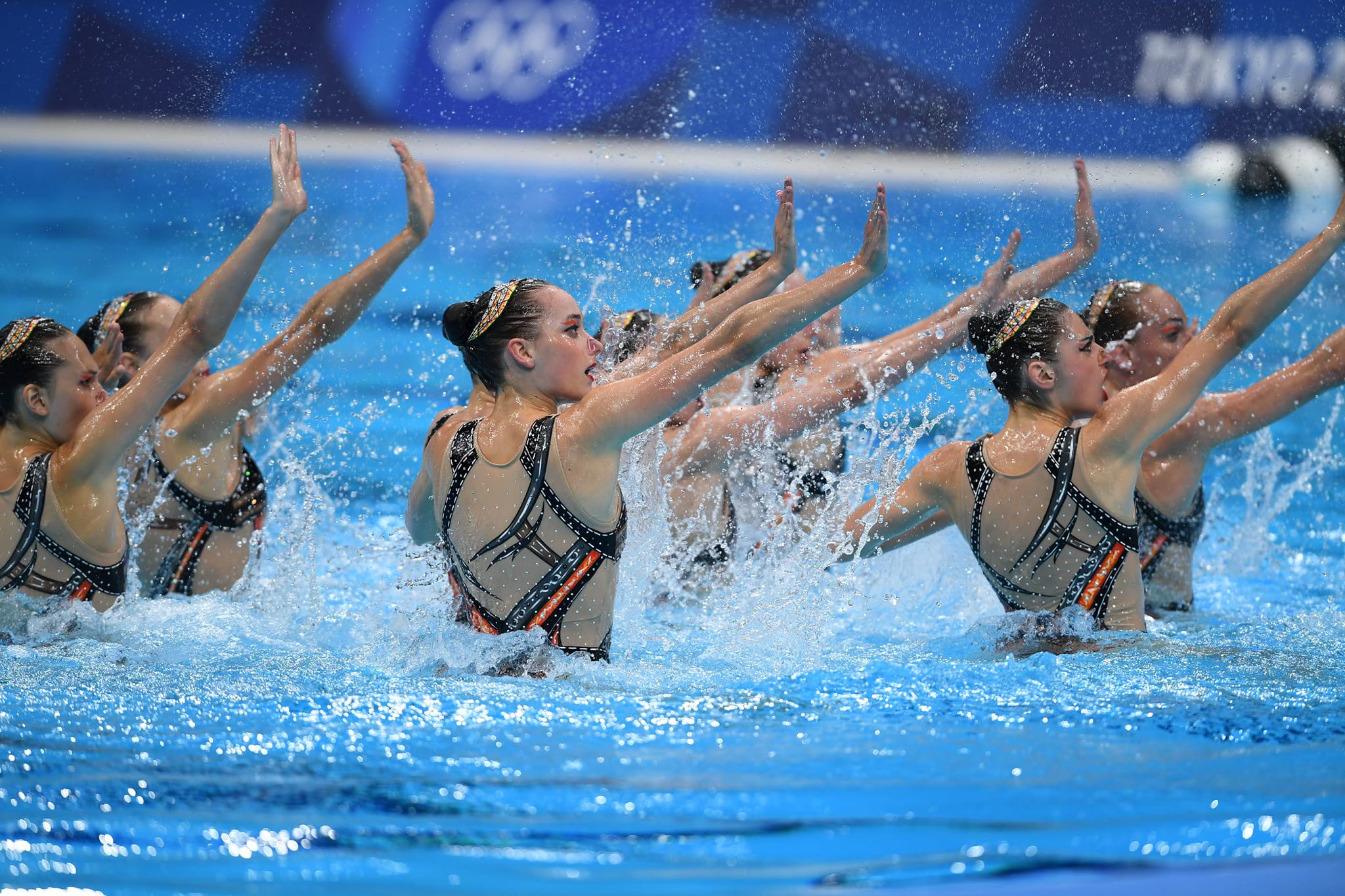
https://commons.wikimedia.org/wiki/File:Ukrainian_artistic_swimming_team_at_Tokyo_2020.jpg
INDUSTRY NEWS📡
FIFA and Hawk-Eye Innovations have launched the Football Technology Centre, a joint venture to advance football technology. This partnership will develop algorithms to automate on-field event detection, enhance decision-making, and create automated offside technology for faster, consistent officiating. FIFA aims to improve operational efficiency and integrity in football by optimising data collection and analysis. This technology will benefit FIFA's 211 member associations by enabling precise, fair, and rapid decision-making, enhancing the football experience for fans and officials worldwide.
Read more: FIFA and Hawk-Eye Joint Venture.

-oOo- -oOo- -oOo- -oOo- -oOo- -oOo- -oOo- -oOo- -oOo- -oOo- -oOo- -oOo-
Please subscribe to make sure you get a weekly newsletter. The next newsletter will be published on 19 November 2024.